Pattaya Days Gone
An ordinary backup from an extraordinary website
It was exactly a month ago that I turned up for the Thailand round of the FIM World Motocross World Championship; only to discover that I was a month too early for the event. Still, I did manage to capture a few action shots.
One month on and we jumped into the car this morning to attend the first day of the three day event. Rolled up and 1000 and paid the 500 baht per person entry fee; a little steep but it’s a world championship event so one can expect to pay a little more than a club race at Bira. Sunday will cost 1,000 baht.
Down the track and the first surprise was that it was covered in tractors rather than bikes; it appeared they were still building it. All there was on offer were a few tents selling bike bits and a McDonald’s outlet. I asked around. No track action today at all, I was told, today is just a “meet and greet”. So it appeared I had paid 1,000 baht for the two of us to avoid a McDonald’s and look at motor bike exhausts for sale.
Quite staggering that an international sporting event can be held over three days; and then nothing at all happens for paying spectators on the first day….
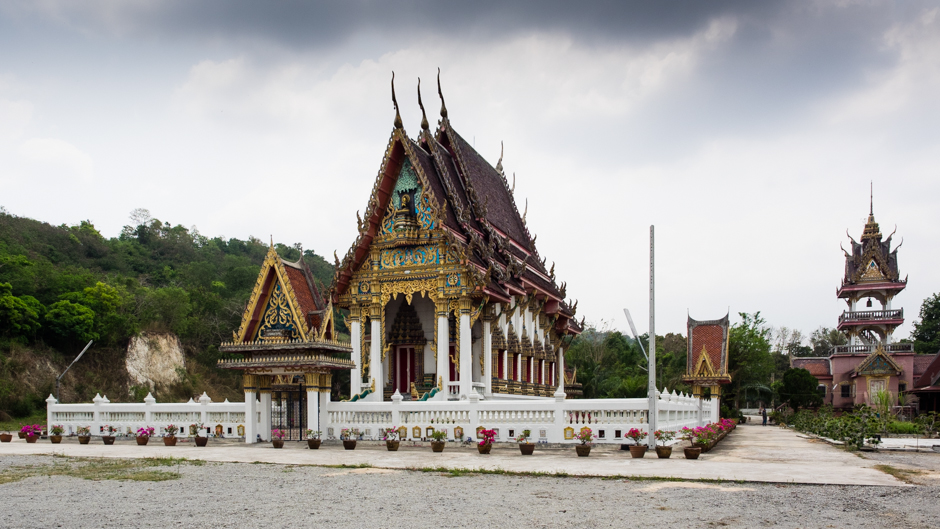
We wandered around for 45 minutes and then left in disgust. For something to do we looked at a temple on the way home. It wasn’t very good.
Pattaya’s Beach Road is similar to seaside promenades at many resort cities; but with more prostitutes.
The prostitutes are rounded up every few months, fined 200 baht, and then disgorged onto the street again. As for the road itself, it has been the subject of many make-overs. A project of a few years ago, to move cables underground or some similar nonsense, dragged on for a couple of high seasons and made both driving and walking a complete nightmare. So when yet another project was announced last year, eons of misery were anticipated.
The project involved widening the road and rebuilding the sidewalk (again). The intention being that traffic would flow more freely, therefore making the prostitutes less visible (not explicitly stated). The problem with this initiative is that the traffic chaos originates at the bend at the end of Beach Road, next to Walking Street and a set of traffic lights. No matter how quickly you progress down Beach Road, you are still going to hit the jam at the end. It’s like having a partially blocked sink drain, and then planning to resolve it by building a bigger sink.
Still, logic never gets in the way of construction contracts and before long everything was being ripped up and replaced. And whilst I love the opportunity to bitch and moan, I have to say that they completed the work reasonably quickly and the end result is pretty good. You can now whizz down Beach Road at a decent rate of speed before grinding to a halt at the snarl-up at the end. They have installed a couple of speed bumps, which are great for catching a bit of air if you get the launch speed correct (the one outside the police station is particularly satisfying); and you can really scare the shit out of crowds of Chinese tourists who foolishly believe that the pedestrian crossing actually give them some rights.
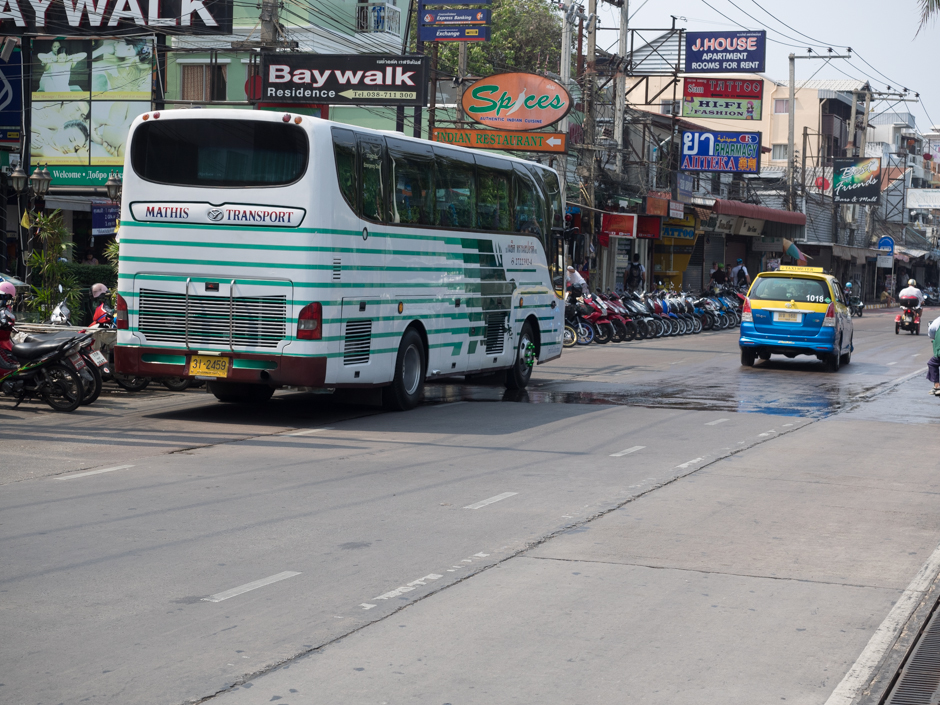
All this is courtesy of an additional lane, and red lines on the outer lane which prevent parking (mainly). Theoretically this should give us three and a bit lanes for the Beach Road Grand Prix; but the bit at the edge is inhabited by motor-bike renters, vendors and people sat on plastic seats for no apparent reason. This leaves three lanes, the inside of which is occupied by parked buses, baht buses chasing passengers and goods vehicles.

1960 Kiev 2a Rangefinder
During my search for a 1950 Kiev 2, I found this at a very cheap price and decided to indulge. It leaks light through the back panel and is nowhere are smooth to use as the earlier 1950 model; but it looks cool sat next to it on the shelf.

1970 Kiev 4 Rangefinder
The Kiev 4 is fitted with a Selenium cell light meter which still shows some signs of life, but only if you point it directly at the sun. Twenty years after the first production run for Kiev rangefinders, the Soviet push for quantity rather than quality is starting to show and, although the camera works well enough, everything has a more industrial feel to it.

*David Cameron has threatened Russia with diplomatic, political and economic reprisals in response to Moscow’s invasion of Ukraine, with the prime minister telling reporters that Britain had to send a “clear message” to Russia.
Having chaired a meeting of the National Security Council, Cameron said on Monday: “What we want to see is a de-escalation rather than a continuation down the path that the Russian government has taken, violating the sovereignty and territorial integrity of another country.”*
1950 Kiev 2 Rangefinder
In 1925 the Leitz company introduced a 35mm Leica camera which kicked off the small camera revolution. The Karl Zeiss Foundation responded by buying up a number of smaller companies and merged them all to form Zeiss Ikon AG, which then attempted to produce alternatives to the Leica; initially not very successfully
In 1932 Zeiss Ikon released the Contax 1 which on paper looked excellent, but in reality featured a shutter from hell that failed almost as often as it worked. Back to the drawing board and in 1936 came the Contax 2.

The shutter problems were fixed, in fact the Contax 2 offered a better shutter than the Leica, plus a more accurate rangefinder, a higher shutter speed, and a wider range of tasty lenses. Zeiss Ikon were well positioned to take over the lead from Leitz as the premier camera company. Then came the war and accidents of geography.
Both companies suffered camera production reductions as they were re-directed into supporting the war effort. Leica production was based in Wetzlar and, although the city was heavily bombed, the Leica factory escaped with only a few blown out windows. Zeiss Ikon, being based in Dresden, were not so lucky, and their production facilities were heavily damaged by bombing. Post war, both cities initially fell under American control, but the boundaries were shifted and Dresden then belonged to the Russians. With more than twenty million war dead, Russia was certainly entitled to reparations, and this camera company was a small part of that. The Russians therefore planned to move their new acquisition to a factory in Russia
As a precursor to the move, everything was taken to a factory near Jena in East Germany where three production lines were set up. One of these was intended to continue the production of the Contax in Germany; and other two were for the production of the same camera for Russia, initially to be called the Volga and then finally the Kiev. In the event; all the production lines were moved to Kiev and the Germans had to start up Contax production at a later time elsewhere.
In the post ware period of 1947-1949, small batches of cameras were produced in Jena. Some were called Contax, some were called Kiev. Some had Contax front plates which were overwritten with “Kiev”. Parts left over from Dresden were mixed with parts produced in Jena (collectors can identify which bit is which) and the differences can be as subtle as the design as the arrow on the rewind knob. But the cameras were essentially the same machine; high-end expensive precision cameras that cost more than a Rolex watch at the time.
If you can find a 47-49 Contax or Kiev then you will be paying big money for a collector’s piece as only a few hundred were made.
Production of the Kiev (camera) in Kiev (place) finally started in 1950; and if you can find a model from this year you are getting something very close to the original Contax, produced at a time when German engineers were on site overseeing production. Quality stayed high till the mid-fifties and then started to decline as tooling was simplified and production targets became more important than quality control. So I was very happy to acquire a 1950 Kiev 2.

Maybe it’s just me; but the last year has been unspectacular at the cinema. Which makes it rather difficult to be excited about tonight’s annual self-congratulatory wank-fest that is the Oscars.
Most of the “Best Picture” nominations are competent enough movies; but none really stands out, other than perhaps 12 Years a Slave, which tackles a subject most Caucasians would rather forget in sufficiently harrowing detail that you are unlikely to come out of the cinema and immediately forget it. That’s probably reason enough to give it a statue, because the rest are entertaining without being emotionally engaging.
Have spent some time updating the “My camera collection” section of this site and have now added details on five film cameras. That’s not all of them; then there are the digital cameras, and all the lenses. Ridiculous; but I love them all for different reasons.
Click the link at the top of the page, or here.
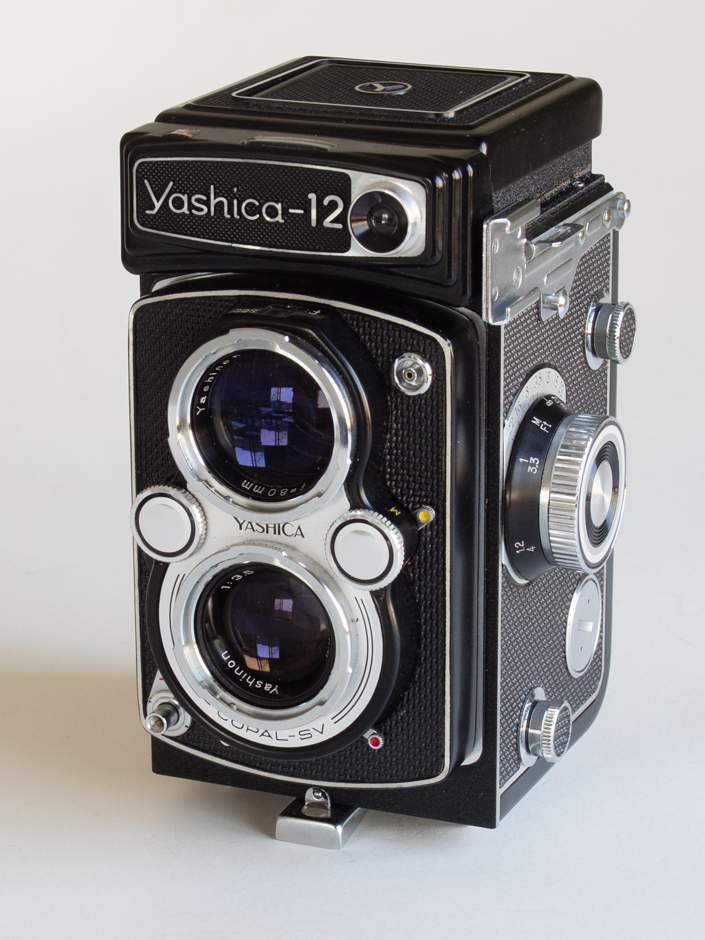
Yashica 12
It’s all very well having 35mm film cameras; but if you are going to mess around with film why not go all the way and use medium format 120 film? Bigger negatives to play with, and much easier to handle if you want to develop the film yourself. Plus, with only twelve shots per roll; you don’t have to take so many photos before finding out that you have made a complete cock-up of everything.
With this in mind I started cruising eBay. There were many choices; Rolleiflex and Hasselblad looked tempting, but the price tags were prohibitive unless you are serious about film photography; and I am not. So I settled for this: