
Pattaya Days Gone
An ordinary backup from an extraordinary website
Yashica 635
I had already indulged in a Yashica 12 (see this page for more information the Yashica 12 and Yashica TLR cameras). One Yashica TLR is enough, but when I walked into the SiamTLR shop in Bangkok, and there was a Yashica 635 in very good condition for a very reasonable price. I couldn’t resist.


Ten years ago today was my last days of employment. After thirty seven years of working for “the man” (and an occasional woman), I was cast aside onto the scrapheap of humanity. Made redundant, discarded, unemployed; after so many years of faithful service.
To be fair, my employer of more than thirty years did ask me whereabouts in the world I would like to work once I had finished in Bangkok. Unfortunately most of the options seemed to indicate either Holland or, perish the thought, the UK. And after living in Thailand, anywhere else seemed a bit of a let-down, even if it did involve a salary. So, ever the dedicated employee, my immediate answer was “redundancy please”; or as it was known in company myth, “the package”.
Zero Image Pinhole camera A long time ago (about 2,500 years) in a land far away (China) a man by the name of Mo-Ti observed that light passing through a small hole projected an image on a surface. And that was the start of photography.
Over the next couple of thousand years, this idea was employed mainly for the study of the heavens, with astronomers and scientists building elaborate structures, or annoying their wives by taking over the living room, and then lighting a wall from a small hole that let in the light. In the seventeenth century Johannes Kepler decided it would be useful if these dark rooms with holes in them should have a name, so he called them camera obscura (camera=vaulted chamber in Latin, obscura=dark). By this time, the camera obscura was being used with a lens rather than a pinhole by artists who wanted to project an image and then draw it. Indeed there is some conjecture that some of the great artists were tracing their masterpieces inside a camera obscura rather than drawing from observation; the cads!

The lens based camera obscura became more popular; but the basic pin-sized hole technique retained a following and as is so often the case, it took a Scotsman, Sir David Brewster, to give this technique a name: pinhole photography. Although Sir David only invented the pinhole bit, the word photography had already been coined by Sir John Herschel (if you didn’t have a knighthood, you weren’t allowed to name things).
In the early part of the last century, pinhole photography died away a little, but has seen a resurgence since the 1960s as people come back to the most basic form of photography, a box with a hole in it.
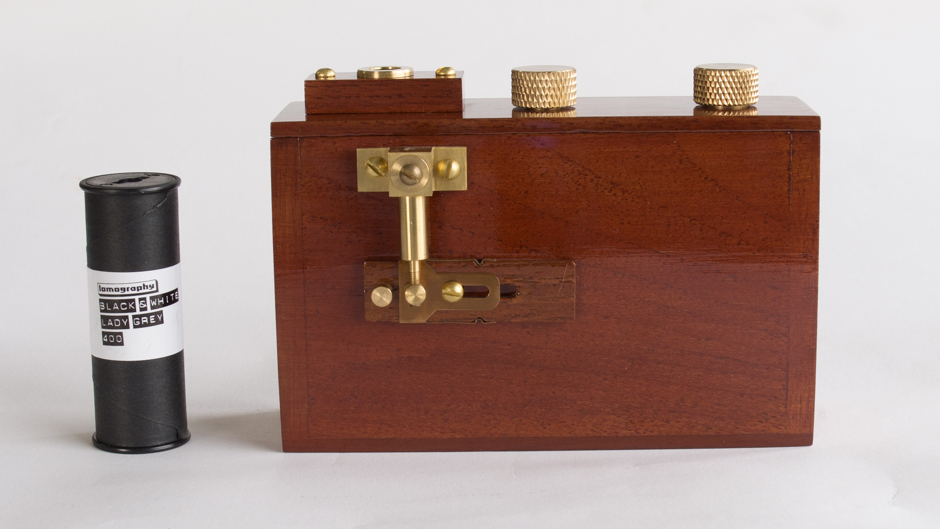
I like pinhole photographs. Some pinhole photos (none of mine) are extremely evocative and artistic. I bought a Pinwide pinhole “lens” for Micro Four Thirds and I play with it occasionally; but it is not the proper pinhole experience. Pinhole photos should be taken on film using a camera with minimal controls. There should be considerable uncertainty as to the outcome. The camera should not be a modern metal contraption, it should be made of wood. It should be something like this:
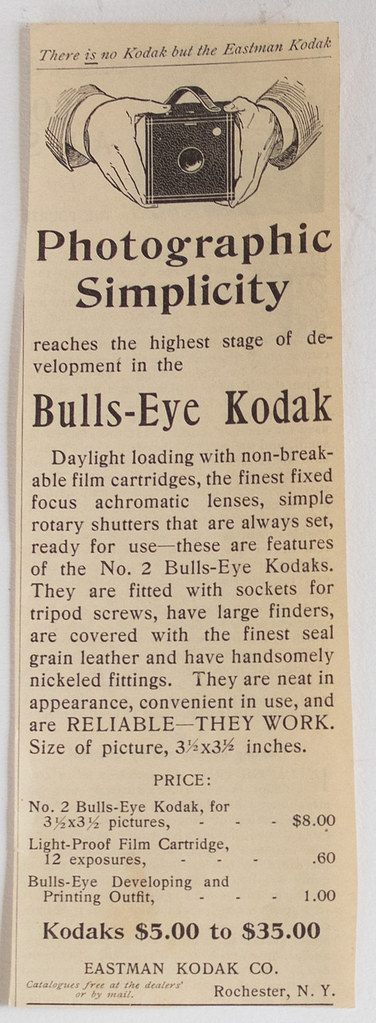
1896 Kodak Bullseye
When George Eastman resigned from his banking job in 1881 and decided to pursue photography, his family must have been disappointed. He was a rising star in the bank; and to give that up to become involved in the nascent camera industry must have seemed rather foolish. History shows that it was actually an excellent decision.
His first cameras featured dry plate backs which, although more convenient than wet plate photography, still required considerable effort to transport and process. But Eastman saw the future lay in roll film and in 1888 he launched the first Kodak camera.

For $25, you would receive the camera loaded with 100 shots on a roll film, and when you were done, you sent the camera back to Kodak for processing and loading of another film; and you paid $10 for that service.
In spite of the high price, sales were brisk, and Kodak released a number of different models in the next few years.
Meanwhile, over in Boston, the imaginatively named Boston Camera Company produced the Bulls-Eye camera. This was the first camera in the world to use a paper backing on the film, on which was written the exposure numbers; and owners could read off the shot number through a little red window in the back of the camera.

Eastman saw that this was a feature that should be incorporated in all cameras, so he bought the Boston company and in 1896 Kodak announced its own Bulls-Eye camera. The 1896 model had a wooden frame and brass fittings and cost $8.
1963 Ihagee Kine Exakta
The idea of looking through the lens to compose and focus an image goes back to the very early days of photography, with the first SLR camera being credited to Mr. E.W. Smith and his Monocular Duplex in 1884.

Providing SLR facilities in large format cameras was easy enough; but building them into a small body and making them sufficiently effective to allow accurate focusing was more of a challenge; and it wasn’t until the mid-1930s that solutions for 35mm cameras emerged. The first to crack the problem was the Russian made Sport which was prototyped in 1934 and went into production in 1937.

But unfortunately for the Russians, their extended prototyping period meant that the German company Ihagee could release the Kine Exakta in 1936 and thus claim to have the world’s first production 35mm SLR (although it probably didn’t seem that much of a big deal at the time.
Historical enough for me to pick one up, a post-war version and therefore cheap (and with the name changed on the front plate to “Exacta”, presumably to make it more export friendly).

What, one of those flappy mirror monstrosities? Yep; but it’s for an historical cause.
The idea of looking through the lens to compose and focus an image goes back to the very early days of photography, with the first SLR camera being credited to Mr. E.W. Smith and his Monocular Duplex in 1884.
Providing SLR facilities in large format cameras was easy enough; but building them into a small body and making them sufficiently effective to allow accurate focusing was more of a challenge; and it wasn’t until the mid-1930s that solutions for 35mm cameras emerged. The first to crack the problem was the Russian made Sport which was prototyped in 1934 and went into production in 1937.
But unfortunately for the Russians, their extended prototyping period meant that the German company Ihagee could release the Kine Exakta in 1936 and thus claim to have the world’s first production 35mm SLR (although it probably didn’t seem that much of a big deal at the time.
Historical enough for me to pick one up, a post-war version and therefore cheap (and with the name changed on the front plate to “Exacta”, presumably to make it more export friendly).
Two weeks ago, Kevin and I spent a couple of afternoons taking photos of the protesters in Bangkok. At the end of the second day we rested on the steps near Big C; waiting for our wives to return from shopping.
This afternoon a man took his children to Big C. A bomb exploded, his five year old son was killed and his six year old daughter was seriously injured. They had nothing to do with the protests; they were just passing by. Another tragedy amongst many that have occurred over the past few days.
I know I did, sorry….
I no longer photograph polo on a regular basis; which is just as well because I the lens and camera I used to take the pictures have found new homes in California and Ireland respectively. But I was trawling through my tens of thousands of polo shots this morning to choose some to make up a gallery; and I realised I do have some pretty good shots.
Like this one:

